E minor chord
E minor chord for guitar with diagrams, fingerings and notes.
All chords More E chordsAlternative shapes
Em
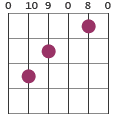
Em
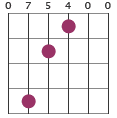
Alternative fingerings
Em

Learn from video
Description and theory
Em is usually played as an open chord, but it's common to play it as a barre chord as well.
Chords that sound good together with E minor
The primary chords to combine with Em in chord progressions are: G, Am, Bm, C, D.
Secondary chords are among many others: Cmaj7, D7, Gmaj7, Am7, B7.
Follow-up chords
Chords that are likely to follow E minor in progressions:
› G
› C
› D
› Am
Finger position (Em chord)
Index (1st) finger or middle (2nd) finger on 5th string, 2nd fret.
Middle (2nd) finger or ring (3rd) finger on 4th string, 2nd fret.
Chord names
The Em is an abbreviation for E minor (a less common abbreviation is Emin).
Theory of Em chord
The notes that the Em chord consists of are E, G, B.To get Em7 add D.
To get Em6 add C#.
Inversions
1st inversion: Em/G (means that G is the bass note).
2nd inversion: Em/B (means that B is the bass note).
Diagrams of these inversions
Assorted slash chords
Versions with alternate bass notes in short notation:
Em/F#: 222000
Em/C: X32000
Em/D: XX0000 / XX0453
Alternative chord names
Em/F# is theoretically identical with Emadd9/F#.
Em/A is theoretically identical with Emadd11/A or A9(no3).
Em/C is theoretically identical with Cmaj7.
Em/C# is theoretically identical with Em6/C#.
Em/D is theoretically identical with Em7/D.
Omissions (dyads)
Em (no3) is an E minor with no third (G).
Em (no5) is an E minor with no fifth (B).
Written in tab format
- 0 -
- 0 -
- 0 -
- 2 -
- 2 -
- 0 -
See The Chord Reference ebook (over 800 chord charts), for a PDF.
Chord progressions
Em - C - D - G
Progressions with diagrams (PDF)
Examples of progressions featuring Em.
| Progression 1: The River - Bruce Springsteen. | ||
|---|---|---|
Em
|
Dadd11
|
Cmaj7
|
| Progression 2: Progression with voicings. | |||
|---|---|---|---|
Em
|
G
|
D
|
C
|