D major chord
D major chord for guitar with diagrams, fingerings and notes.
All chords More D chordsAlternative shapes
D
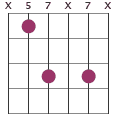
Relevant chords
D/B

D/C

D (no3)

Learn from video
Description and theory
D major is usually played as an open chord, but it's common to play it as a barre chord as well.
Chords that sounds good together with D major
The primary chords to combine with D in chord progressions are: Em, F#m, G, A, Bm.
Follow-up chords
Chords that are likely to follow D major in progressions:
› G
› A
› F#7 (XX4320)
› F
Finger position (D chord)
Index (1st) finger on 3rd string, 2nd fret.
Middle (2nd) finger on 1st string, 2nd fret.
Ring (3rd) finger on 2nd string, 3rd fret.
An alternative finger position with the index finger as a bar over three strings on 2nd fret and the middle finger on 2nd string, 3rd fret, makes combinations with chords such as D6 (XX0432) and D6/9 (XX0452) possible.
Theory of D chord
The notes that the D chord consists of are D, F#, A. The main presented version (xx0232) includes a doubled root, a third and a fifth.
To get D7 add C.
To get Dmaj7 add C#.
To get D6 add B.
Comments
D/B: this is a D major with B as bass note (can also be played as X20032).
D/C: this is a D major with C as bass note.
D (no3): this is a D major without the third (F#) and is identical with D5. A tip is to combine it with Dsus4/E (XX2035) and Dsus4/G (3X0035). The XX0235 version can also be called D with A on top.
Inversions
1st inversion: D/F# (means that F# is the bass note).
2nd inversion: D/A (means that A is the bass note).
Diagrams of these inversions
Assorted slash chords
Versions with alternate bass notes in short notation:
D/C: X30232
D/C#: X40232
D/Eb: XX1232
D/F: 100232
D/F: D/F is less common compared to D/F# since F is neither a note in the D triad nor in the D major scale.
D/Bb: D/Bb is less common compared to D/B since Bb is neither a note in the D triad nor in the D major scale.
Alternative chord names
D/B is identical with D6/B and Bm7.
D/C is identical with D7/C.
D/C# is identical with Dmaj7/C#.
D/G is identical with Dadd11/G.
Omissions
D (no3) is a D major with no third (F#). D(no3) is theoretically identical with D5.
D (no5) is a D major with no fifth (A).
Written in tab format
- 2 -
- 3 -
- 2 -
- 0 -
- - -
- - -
Go to Lesson for this chord.
Chord progressions
D - G - A - D
Progressions with diagrams (PDF)
Examples of progressions featuring D.
| Progression 1: Barre chords including inversions. | ||||
|---|---|---|---|---|
D
X5777X |
D/C#
X4777X |
Bm
X2443X |
G/D
X5543X |
A/E
X7765X |
| Progression 2: Progression with bass line. | |||
|---|---|---|---|
D
XX0232 |
D/F#
2X0232 |
C/E
032010 |
D
XX0232 |
| Progression 3: I - V - IV progression with bass line. | |||
|---|---|---|---|
D
XX0232 |
A/C#
X42220 |
G/B
X20033 |
D
XX0232 |
| Progression 4: I - V - ii progression. | ||
|---|---|---|
D
XX0232 |
A
X02220 |
Em
022000 |
| Progression 5: I - iii - IV progression. | |||
|---|---|---|---|
D
XX0232 |
F#m
244222 |
Bm
X24432 |
G
320003 |
| Progression 6: Movable shapes. | ||
|---|---|---|
D
XX0232 |
F/D
XX0565 |
G/D
XX0787 |
| Progression 7: Love Is All Around - The Troggs. | |||||
|---|---|---|---|---|---|
D
|
Em
|
G
|
A
|
D
|
|