Aug chords
The aug (augmented) chord, along with the dim chord, are two types of triads that are far less common than major and minor triads. The aug chord is sometimes written with a plus (+) symbol, such as C+.
When these chords occur in songs, they are for the most part used sporadically, often between two major chords, and can bring subtle interest to the harmony of the song (see some suggestion of progressions at the end of the page).
To summarize the aug chord from a theoretical point of view, the chord consists of a root, a major third and an augmented fifth. If C major and Caug is compared, what happens is that C, E and G changes to C, E and G#. The augmented fifth is the reason that the same chord also is marked with a +5 symbol, for example C+5.
Aug chords
Caug
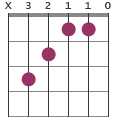
Daug
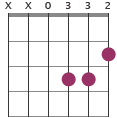
Eaug
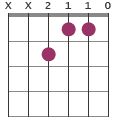
Faug
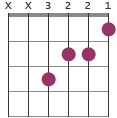
Gaug
Aaug

Baug

Comments
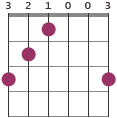
The diagrams above show possibilities for open-position augmented chords.
A simpler fingering for Caug is X321XX. A simpler fingering for Faug is XX322X. A simpler fingering for Aaug is X0322X.
Movable shapes
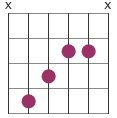
You only need to learn one movable shape to play all aug chords:
Aug shape
Comments
The shape above has the root on the fifth string (i.e. the second thickest). So to play, for example Caug, the bass note should be on the third fret, see all keys written out below.
Chord progressions with the aug chord
Aug chords are often used directly after a major chord in the same key, here are some examples:
C - Caug - C6 - C7
D - Daug - D6 - D7
Note the movement from D including a perfect fifth, Daug including a raised fifth, D6 including a
sixth and D7 including a minor seventh.
G - Gaug - Em
Especially the G - Gaug - Em sequence is very easy to play since the small movements involved. Here you should use Gaug in open position.
A - Aaug - F#m
It results in a natural great voice-leading if F# minor is played as XX4222.
C - Caug - Am
The following progression using the same bass note throughout and the highest note is all the time moved one semi-note up.
C - Caug - Am/C - C7
A progression including two augmented chords:
F - Faug - Bb - G - Gaug - C
Aug chords are in some situations more convenient for the piano and therefore more often used in arrangements for that instrument. This is because only one finger has to be move to a new key in sequence such as C - Caug or D - Daug, which seldom is the case for the guitar, at least not when open chords are involved. One of the exceptions is the G (320003) - Gaug (321003) sequence.
Overview
All aug chords listed with the same movable shapes written in short notation.
Caug - X3211X
C#aug / Dbaug - X4322X
Daug - X5433X
D#aug / Ebaug - X6544X
Eaug - X7655X
Faug - X8766X
F#aug / Gbaug - X9877X
Gaug - 10 9 8 8 X X
G#aug / Abaug - X 11 10 9 9 X
Aaug - X 12 11 10 10 X
A#aug / Bbaug - X 13 12 11 11 X
Baug - X2100X
A chord progression including an aug chord using the shape above:
C - Caug - Am
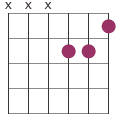
An alternative shape including only three strings:
Aug shape 2
Comments
The three-string shape above becomes Aaug if played with the base note on the second fret.
Three-string voicings overview
A selection of aug chords listed with the same movable shapes written in short notation.
Aaug - XXX221
Baug - XXX443
Caug - XXX554
Daug - XXX776
Eaug - XXX998
Faug - XXX10 10 9
Gaug - XXX12 12 11
A chord progression including an aug chord using the shape above:
Am/C - Caug - G/B
Suggested chords shapes for Am/C is XXX555 and for G/B is XXX433.
Chord structure
The augmented triad is built with the formula 1-3-#5.
The structure is: Root (1st note), major 3rd (4 semitones above the root), augmented 5th (8 semitones above the root).
All aug inversions listed with notes
The list includes all aug chords with 12 root notes:
Caug (C, E, G#)
Root Position: C - E - G#
1st inversion: E - G# - C
2nd inversion: G# - C - E
C#aug (C#, E#, G##)
Root Position: C# - E# - G##
1st inversion: E# - G## - C#
2nd inversion: G## - C# - E#
Daug (D, F#, A#)
Root Position: D - F# - A#
1st inversion: F# - A# - D
2nd inversion: A# - D - F#
D#aug (D#, F##, A##)
Root Position: D# - F## - A##
1st inversion: F## - A## - D#
2nd inversion: A## - D# - F##
Eaug (E, G#, C)
Root Position: E - G# - C
1st inversion: G# - C - E
2nd inversion: C - E - G#
Faug (F, A, C#)
Root Position: F - A - C#
1st inversion: A - C# - F
2nd inversion: C# - F - A
F#aug (F#, A#, C##)
Root Position: F# - A# - C##
1st inversion: A# - C## - F#
2nd inversion: C## - F# - A#
Gaug (G, B, D#)
Root Position: G - B - D#
1st inversion: B - D# - G
2nd inversion: D# - G - B
G#aug (G#, B#, D##)
Root Position: G# - B# - D##
1st inversion: B# - D## - G#
2nd inversion: D## - G# - B#
Aaug (A, C#, E#)
Root Position: A - C# - E#
1st inversion: C# - E# - A
2nd inversion: E# - A - C#
A#aug (A#, C##, E##)
Root Position: A# - C## - E##
1st inversion: C## - E## - A#
2nd inversion: E## - A# - C##
Baug (B, D#, F##)
Root Position: B - D# - F##
1st inversion: D# - F## - B
2nd inversion: F## - B - D#
Chord relationship and alternative chord names
Caug is theoretically identical with Eaug/C.
Daug is theoretically identical with F#aug/D.
Eaug is theoretically identical with G#aug/E.
Faug is theoretically identical with Aaug/F.
Gaug is theoretically identical with Baug/B.
Aaug is theoretically identical with C#aug/A.
Baug is theoretically identical with D#aug/B.
Aug chords with added notes
There are some "alterations" that might interest you concerning this chord type. For instance augmented with an added 9th:
Caug(add9)
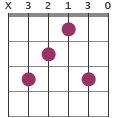
This chord functions similarly to a regular Caug, but with smoother fingerings. In a progression:
C - Caug(add9) - Am
See also augmented 7th chord.