Metal chords
 This article focuses on playing heavy metal on the guitar and gives you instructions about chords that are essential in the metal style. What you should know is that chords and chord progression in the usual sense doesn't fully apply to heavy metal, which is often riff based. Nevertheless, chords are part of the underlying harmony. But, since chords are not the end goal, this guide includes playing examples that shows how to apply chords in a "metal context".
Power chords and modifications
Power chords combined with palm muting (sometimes on an open string played amid chords) and a lot of distortion on the amp makes it sound metal.
Standard power chords
F#5
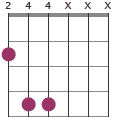
A5

B5
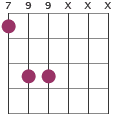
C5

Thiese are only four examples, but the shapes are movable. If needed, go to power chords main section. There are other ways to play these chords, for example without octave doubling or with open strings involved. But these three-note versions are suitable for metal. Go to metal lesson for see the chords in action.
Learn from video
Playing examples using power chords
From this progression:
A5 - D5 - C5 - A5 - G5 - A5
We could accomplish these two approaches:


Distorted rock beyond power chords
To mix it up and create a diversity of note colors, and to make it a little more "sophisticated", we can add some other chords that either can be combined with power chords or work alone.
C/E

Em

F/A
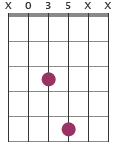
Am

Progressions including some of these chords:
C/E – Em – C/E – Em
Am (X025XX) – F5/C (X335XX) – G5/D (X557XX)
The second "package" of beyond-power-chords ideas:
Aaug(no3)

Adim(no3)

A(no5)

Am(no5)

These two chord types contribute with dissonance and can be combined with power chords. The third and fourth pictured chords can be seen as major and minor dyads with the fifth omitted. They could sometimes be combined with an open D-string. Obviously, all four chords are movable.
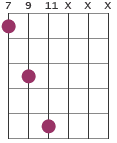
The third "package" of beyond-power-chords ideas (with a reminiscent of Foo Fighters):
Dsus4/G
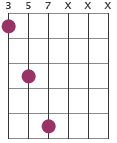
Esus4/A
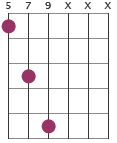
F#sus4/B
Relevant progressions:
E5 (022XX) – C/E – Dsus4/G
A concept with 5th and sus chords:
E5 (X79XXX) – Esus4/A (579XXX) – D5 (X57XX) – Dsus4/G (357XXX)
Note that 077XXX is also an Esus4 alternative that works great in the metal context.
Another concept with double stops and three-strings sus chords:
D5/A (XX77XX) – Dsus4/A (XX778X)
You may want to explore the alternate Drop D tuning in which these chords can be practiced with less stretch for the hand.
Yet another concept using power chords and inversions:
B5 (75XXXX) - BaugG(no3) (7 10 X X X X) - E5/B (775XXX)
The following progression uses power chords shapes in combination with an open B-string:
B5 (X2440X) - C#7 (X4660X) - Bm7/D (X5770X) - E5 (X7990X)
Well-known songs
Run to the Hills
Artist: Iron Maiden
Album: The Number of the Beast (1982)
Chords:
E5 - A5 - D5 - E5 C5 - D5 - G5 - A5 (intro)
Comment: Only one or two strokes per chord. The progression is repeated twice and the second time is the final chords G5 - D5 instead of G5- A5.
Living after Midnight
Artist: Judas Priest
Album: British Steel (1980)
Chords:
E5 - D5 - A5 - B5 (intro & chorus)
Comment: A recommendation is to use the 5th string as bass throughout the whole sequence.
We're Not Gonna Take Take It
Artist: Twisted Sister
Album: Stay Hungry (1984)
Chords:
E5 - D#5 - C#5 - B5 (intro)
Comment: Two strokes per chord.
Heavens on Fire
Artist: Kiss
Album: Animalize (1984)
Chords:
G5 - Bb5 - G5 - Bb - C - Bb - C - Bb - G5 (chorus)
Comment: The progression is repeated two times on the first two occasions in the song and six times the last time.
<< See all styles