Blues – expand your repertoire
After you have learned the basic components of guitar blues such as dominant chords and 12-bar blues progressions, it's time to expand your knowledge in different directions.
Alternate blues accompaniments
Besides common blues shuffle, here is another way to play blues on rhythm guitar:
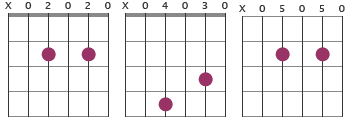
A7, Asus13, A7 (II)
The chords above are A7, Asus13 and an A7 voicing (notice that the first and third chord is not identical).
Play these chords in the sequence: A7 - Asus13 - A7 (II) - Asus13, choose between strumming and fingerpicking.
The following chord trio can be used in 12-bar blues progressions in E.


E7, A7, B7/A
Notice the shapes: A7 and B7 (with A in the bass) uses the E7 shape except for the note on the 5th string. It's also common to combine these A7 and B7 voicings with E7 or E9 on 7th position.
Now, play these chords ...
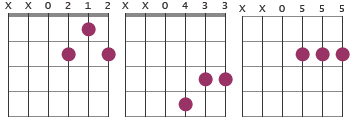
D7, Dsus13, D7/9
The chords above are D7, Dsus13 and D7/9.
Play these chords from left to right, in the sequence: D7 - Dsus13 - D7/9 - Dsus13. Now, play these chords ...
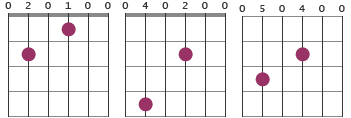
E7, Esus13, E7 (II)
The chords above are E7, Esus13 and an E7 voicing (notice that the first and third chord is not identical).
Play these chords in the sequence: E7 - Esus13 - E7 (II) - Esus13.
In the end, you should try to put it all together with the A7 bundle, D7 bundle and E7 bundle in a sequence.
Here is an example of a simple arrangement:

Add new chords in the turnaround
Another way to expand the chord progression in blues is to add new chord in the turnaround (the last part in the 12-bar structure). For blues in E, C#7 and Fm#7 can be added. These two can be simplified into X434XX and 2X22XX and be incorporated in the last part as C#7 - F#m7 - B7 - E.
Go to next article in the course: 12-bar blues chords.
Go back to the main section of Blues guitar.